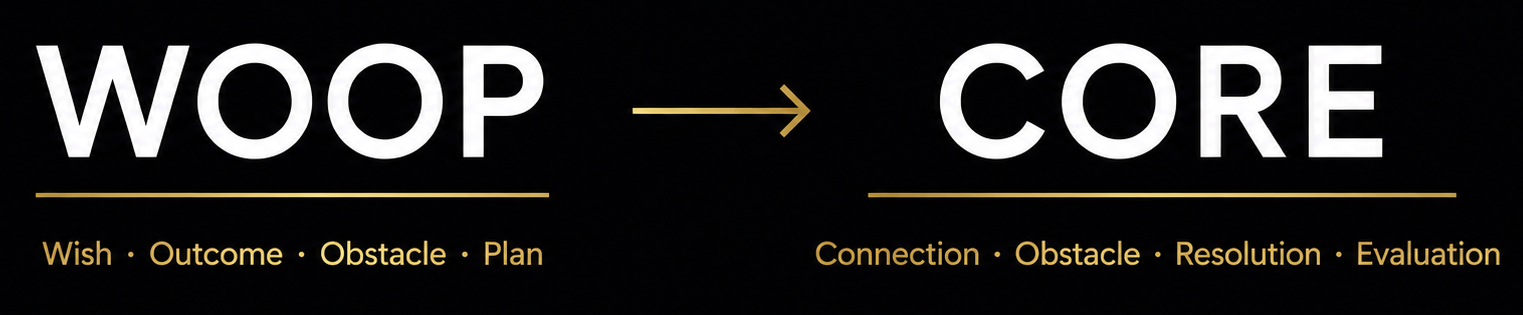
The WOOP-CORE Method. A Framework for Career Positioning.
This is not a resume framework. It is a positioning intelligence system built on how you actually think, lead, and create value.
Most professionals go straight to writing — and end up with a resume that lists what they did instead of communicating what it means. That is why strong candidates get passed over. Not because they lack experience. Because their materials do not translate that experience into the language decision-makers respond to at the level they are targeting.
The WOOP-CORE Method fixes that at the root. It is a five-layer process that starts with your values, builds a language profile from how you think and lead, excavates the real impact buried in your career history, and translates all of it into positioning that answers the three questions every hiring decision comes down to.
Before I Write a Single Word, I Need to Know How You Think.
Two people can have identical titles, identical industries, and identical years of experience — and need completely different positioning. Not because their backgrounds are different. Because the way they want to be seen is different. The companies they are trying to reach are different. And the language those companies respond to is different.
The WOOP-CORE Method is built around that reality. Every layer of the process informs the next. The resume that comes out the other side is not a formatted version of your work history. It is a strategic document built on how you actually think, lead, and create value — and aimed precisely at the hiring audience you are trying to reach.
Your Values Tell Me Which Language to Use.
When I ask about your values in the Career Assessment I am not doing a personality exercise. I am mapping your positioning language.
A professional who says they want work-life balance and a professional who says they want to climb the corporate ladder need completely different resumes. Not because their experience is different — but because the hiring environments they are targeting respond to different signals.
The work-life balance candidate leads with collaborative systems, team enablement, sustainable operations, and structures that scale without heroic individual effort. Their positioning story is about building environments where teams do exceptional work consistently — and having the systems and results to prove it.
The corporate ladder candidate leads with directive leadership, executive visibility, P&L ownership, and measurable business outcomes tied to the bottom line. Their positioning story is about driving results, owning numbers, and moving organizations forward at a level decision-makers recognize immediately.
Same industry. Same tenure. Completely different language. Completely different positioning. And the wrong language aimed at the wrong audience produces the wrong result — regardless of how strong the underlying experience actually is.
The Core Values Index Is Not a Test. It Is a Translation Tool.
The Core Values Index measures four primary ways people process the world and make decisions — Builder, Merchant, Innovator, and Banker. Most senior professionals lead with a combination of two.
I do not administer a standardized CVI instrument. I use your own language — your values answers, your word choices, the way you describe obstacles and outcomes throughout the Career Assessment — to identify your CVI positioning profile. This is a proprietary interpretive process I developed to extract positioning language that is authentic to how you actually think and lead.
A Builder-Banker profile — the most common among professionals who want to climb the corporate ladder — calls for directive language, metric-driven bullets, budget and headcount authority, and executive-visibility framing. The positioning story is about results, scale, and ownership.
An Innovator-Merchant profile — the most common among professionals who value collaboration and sustainable impact — calls for systems language, team-enabling bullets, cross-functional leadership, and mission-connected framing. The positioning story is about building what works and bringing people with you.
The result is positioning that sounds like you — because it is built from what you said, not from a template applied to your job titles.
The Five Layers of the WOOP-CORE Method.
Every engagement moves through the same five layers in the same order. None of them can be skipped. Each one produces something the next layer requires.
Layer 1 — Values and Vision
What do you stand for and where are you going? Your answers here determine the positioning language strategy for everything that follows. This is not a career clarity exercise — it is the foundation of the language map I build for your materials.
Layer 2 — CVI Positioning Profile
Based on your language, your values answers, and the patterns I identify across your Career Assessment responses, I develop your CVI positioning profile. This profile determines the specific leadership language, metric emphasis, and bullet structure used throughout your resume, LinkedIn, and interview narrative. Builder-Banker or Innovator-Merchant — the profile changes everything about how your value is communicated.
Layer 3 — WOOP Excavation
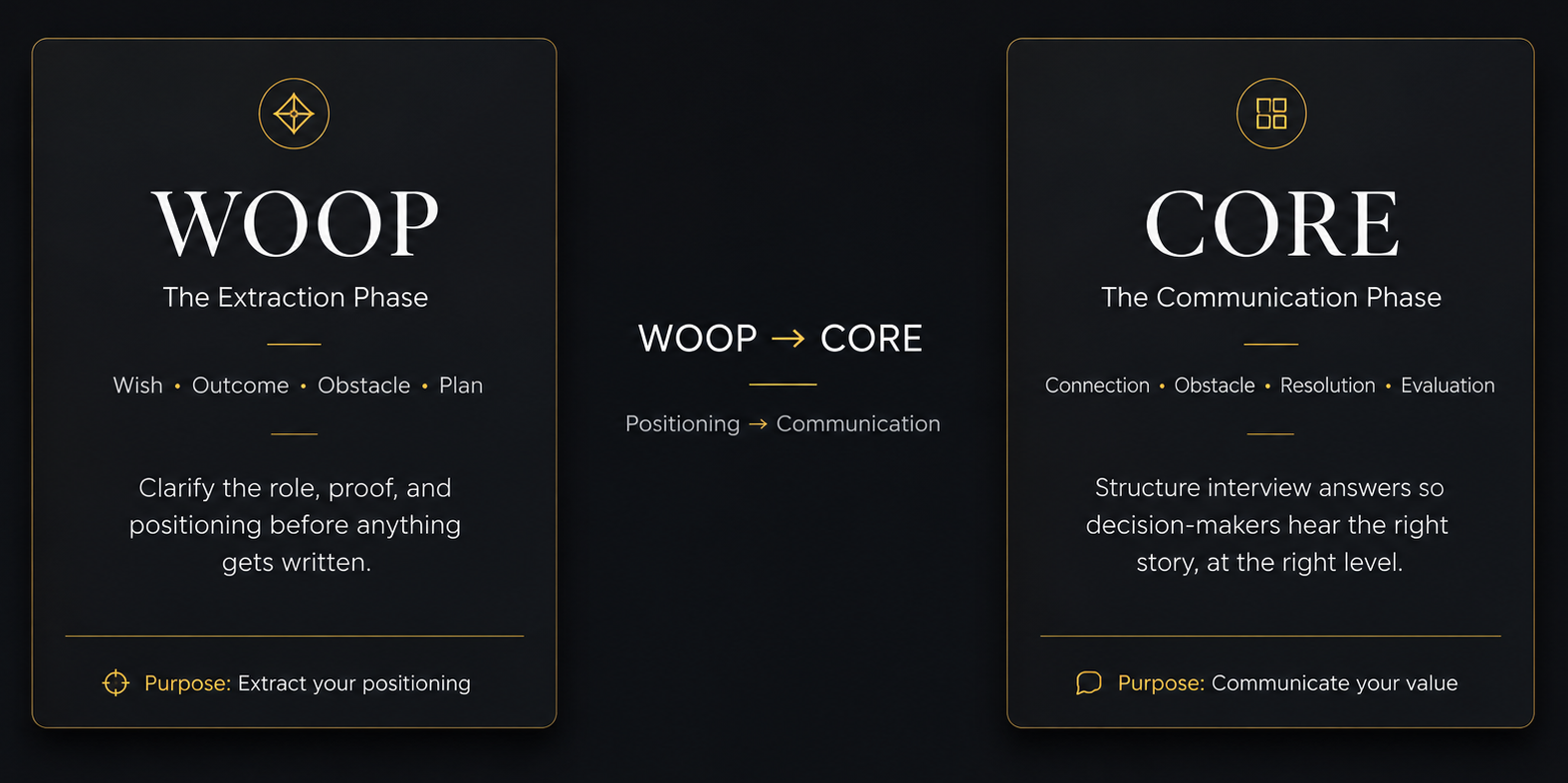
This is where the raw material comes from. For each major role and project you walk through four questions.
Want — What was the goal, challenge, or opportunity you were working toward?
Outcome — What measurable result or impact did you create? Numbers, scope, quality, risk, speed, people, money.
Obstacle — What made the work difficult? What resistance, constraint, or complexity did you navigate?
Plan — What did you actually do? What leadership action, strategy, system, or process did you implement?
Most resumes describe outcomes without context. A 20% improvement in audit readiness means almost nothing to a hiring decision-maker without knowing the starting point, the scope of the effort, who was involved, and what made it difficult. WOOP excavation pulls all of that out — the cross-functional scope, the team size, the SME leadership, the before-and-after — the context that turns a number into a story worth reading.
Layer 4 — CORE Translation
I take what WOOP excavated and translate it into positioning language calibrated to your CVI profile. The CORE phase is where the language strategy becomes actual copy — resume bullets, LinkedIn About section, summary statement, and interview narrative language built on everything the first three layers produced.
CORE stands for:
Communicate — Lead with what you are known for, not what you were responsible for.
Own — Every bullet reflects ownership of outcomes, not participation in activity.
Resonate — The language matches the hiring audience you are targeting, not a generic professional reader.
Elevate — The materials read at the level you are targeting — not the level you are coming from.
Layer 5 — The Three-Question Filter
Before any draft leaves my hands every line is run through the same three questions. These are the three questions every company hiring at the senior level is actually asking — consciously or not — when they read a resume.
How do you save me money?
How do you make me money?
How do you keep me out of jail?
That is it. Every bullet, every summary line, every LinkedIn section needs to answer at least one of those questions clearly and quickly. If a line does not earn its place by answering one of them it does not survive to the draft.
Every Engagement Is Built on This Method.
Whether you come to me for your resume, your LinkedIn profile, your interview narrative, or all three — the WOOP-CORE Method is the foundation. The method does not change. What changes is how it is applied to your specific experience, your specific target audience, and your specific positioning gap.
Your resume becomes a positioning document — not a career history.
Your LinkedIn creates traction instead of just existing — surfacing you to recruiters and decision-makers who are already looking for someone with your profile.
Your interview answers land at the level you are targeting — with the specificity, the context, and the confidence that decision-makers respond to.
The method works because it does not start with the document. It starts with you — your values, your language, your real impact — and builds everything from there.
Ready to See What the Method Produces?